EV vs. Hybrid Cars – Which Is Better for Indian Roads?
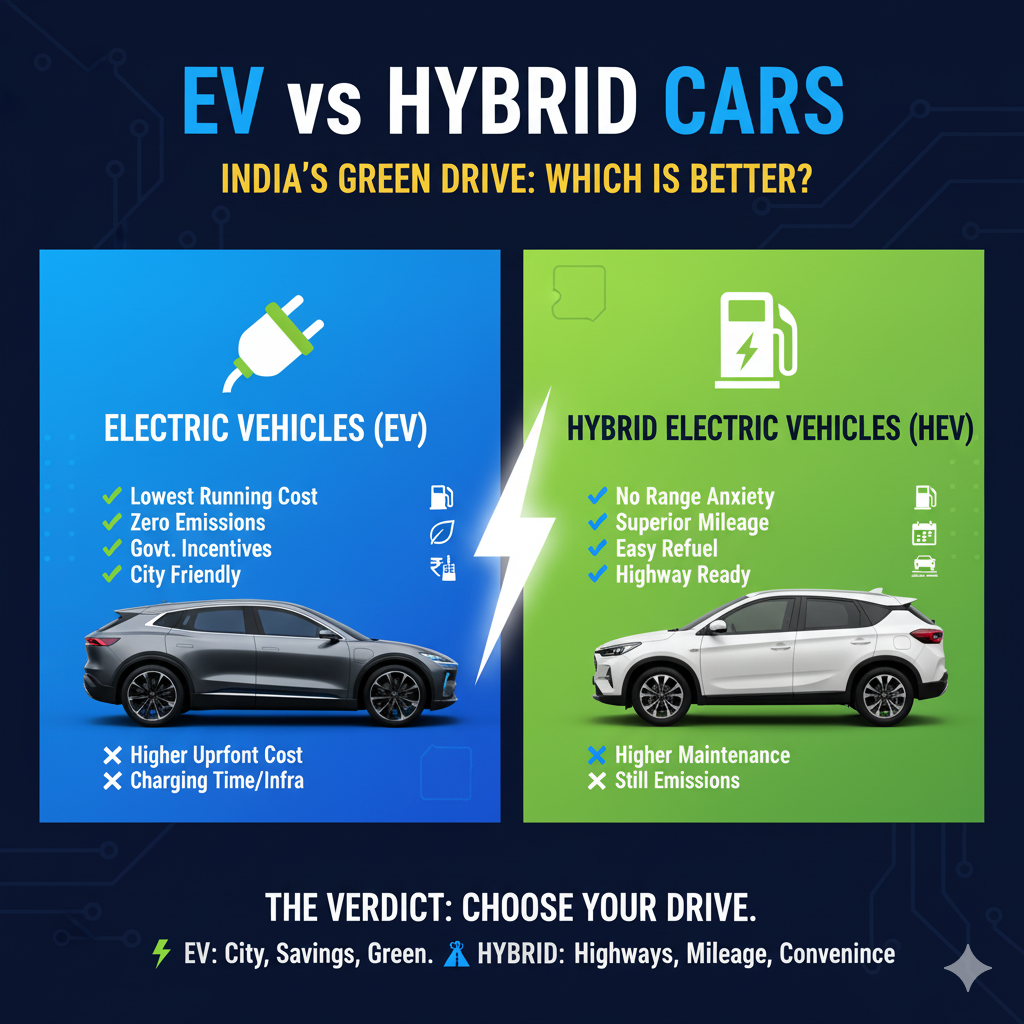
The Indian automotive landscape is witnessing a thrilling transition towards cleaner mobility, primarily driven by Electric Vehicles (EVs) and Hybrid Electric Vehicles (HEVs). For the average Indian car buyer, choosing between these two green options is a complex decision, one that hinges heavily on specific driving needs and the evolving infrastructure across the country.
Here is a breakdown of how EVs and Hybrid cars stack up, especially when judged by the unique conditions of Indian roads.
Electric Vehicles (EVs): The Zero-Emission Future
Fully electric cars, powered solely by a large battery pack, represent the ultimate step towards a zero-tailpipe-emission future.1
The EV Edge for India:
- Lowest Running Costs: Electricity is significantly cheaper than petrol or diesel.2 EV owners often report running costs as low as $\text{₹}1-\text{₹}2$ per kilometer, offering massive savings, especially for high-mileage drivers.
- Lower Maintenance: With fewer moving parts (no engine oil, spark plugs, clutch, exhaust system), EVs have substantially lower scheduled maintenance costs and fewer things that can break down.3
- Government Incentives: EVs currently benefit from strong Central Government incentives (like FAME-II subsidies) and state-specific benefits like Road Tax and Registration Fee waivers, offsetting the higher initial purchase price.4
- Ideal for City Commutes: The instant torque provides quick, smooth acceleration—perfect for navigating dense city traffic.5 Zero tailpipe emissions make them the best choice for improving urban air quality.6
The EV Challenges on Indian Roads:
- Range Anxiety: While improving, the maximum range of most mass-market EVs still raises concerns for frequent long-distance or inter-city travel, especially outside the major metropolitan corridors.7
- Charging Infrastructure: Though rapidly expanding in major cities and on select national highways, the public charging network is still nascent in smaller towns and rural areas.8 This makes home or office charging a necessity.
- Higher Upfront Cost: The battery technology makes the initial purchase price of an EV significantly higher than an equivalent petrol or hybrid car.9
- Charging Time: Even with DC fast chargers, charging an EV takes 30 minutes to an hour (for a significant top-up), which is a major time commitment compared to a 5-minute fuel refill.10
Hybrid Cars (HEVs): The Best of Both Worlds
Hybrid vehicles combine an Internal Combustion Engine (ICE), usually petrol, with an electric motor and a small battery.11 They offer a compromise by leveraging the strengths of both powertrains.12
The Hybrid Edge for India:
- No Range Anxiety: Since they have a petrol engine, hybrids can be refueled at any petrol pump nationwide, completely eliminating range and charging anxiety. This makes them ideal for long-distance highway travel.
- Superior Fuel Efficiency: The electric motor assists the petrol engine, particularly in stop-and-go traffic where it can run solely on the battery, resulting in exceptional fuel efficiency (often 13$25 \text{ kmpl}$ or more for strong hybrids).14 This translates to immediate savings on fuel.
- Familiarity and Service: Hybrids operate much like traditional cars and benefit from an established service and repair network, which is a major plus point across all parts of India.15
- Lower Upfront Cost (Compared to EV): While more expensive than pure-petrol cars, strong hybrids are often priced lower than their fully electric counterparts.
The Hybrid Challenges on Indian Roads:
- Higher Maintenance Complexity: They have a dual powertrain—both a petrol engine and an electric motor—which means higher complexity and potentially higher long-term maintenance costs than a pure EV.16
- Emissions Still Exist: They still produce tailpipe emissions and rely on fossil fuel, making them a halfway measure on the path to green mobility compared to the zero-emission EV.17
- Fewer Incentives: Hybrid vehicles, particularly mild hybrids, generally receive fewer government subsidies and tax benefits than EVs.18
The Verdict: Which is Better for You?
The choice ultimately depends on your primary driving profile in India:
| Driving Scenario | EV (Electric Vehicle) | Hybrid (HEV) |
| Primarily City Commute | WINNER: Lower running cost, zero emissions, instant torque is great for traffic, and home/office charging is feasible. | Good fuel efficiency in traffic, but running cost is higher than EV. |
| Frequent Long Highway Trips | CHALLENGER: Range and charging infrastructure can be a limiting factor. Requires planning. | WINNER: Zero range anxiety, quick refueling, and high highway mileage. |
| Budget & Initial Cost | Higher upfront investment. | More affordable upfront. |
| Environmental Priority | WINNER: Zero tailpipe emissions. | Reduced emissions compared to petrol cars. |
The Bottom Line:
- Choose an EV if your daily commute is primarily within a metro city or area with established charging infrastructure, and you are looking for the absolute lowest long-term running and maintenance costs, prioritizing a green future.19
- Choose a Hybrid if you frequently travel long distances, are concerned about the current charging network, and want an immediate, significant improvement in fuel efficiency and lower emissions without fundamentally changing your refueling habits.20
As India’s charging infrastructure matures, the scale will continue to tip more decisively in favour of the Electric Vehicle. For now, both technologies offer a compelling and practical alternative to traditional petrol and diesel cars.