Maruti Suzuki Baleno vs Hyundai i20 – Premium Hatchback Face-off
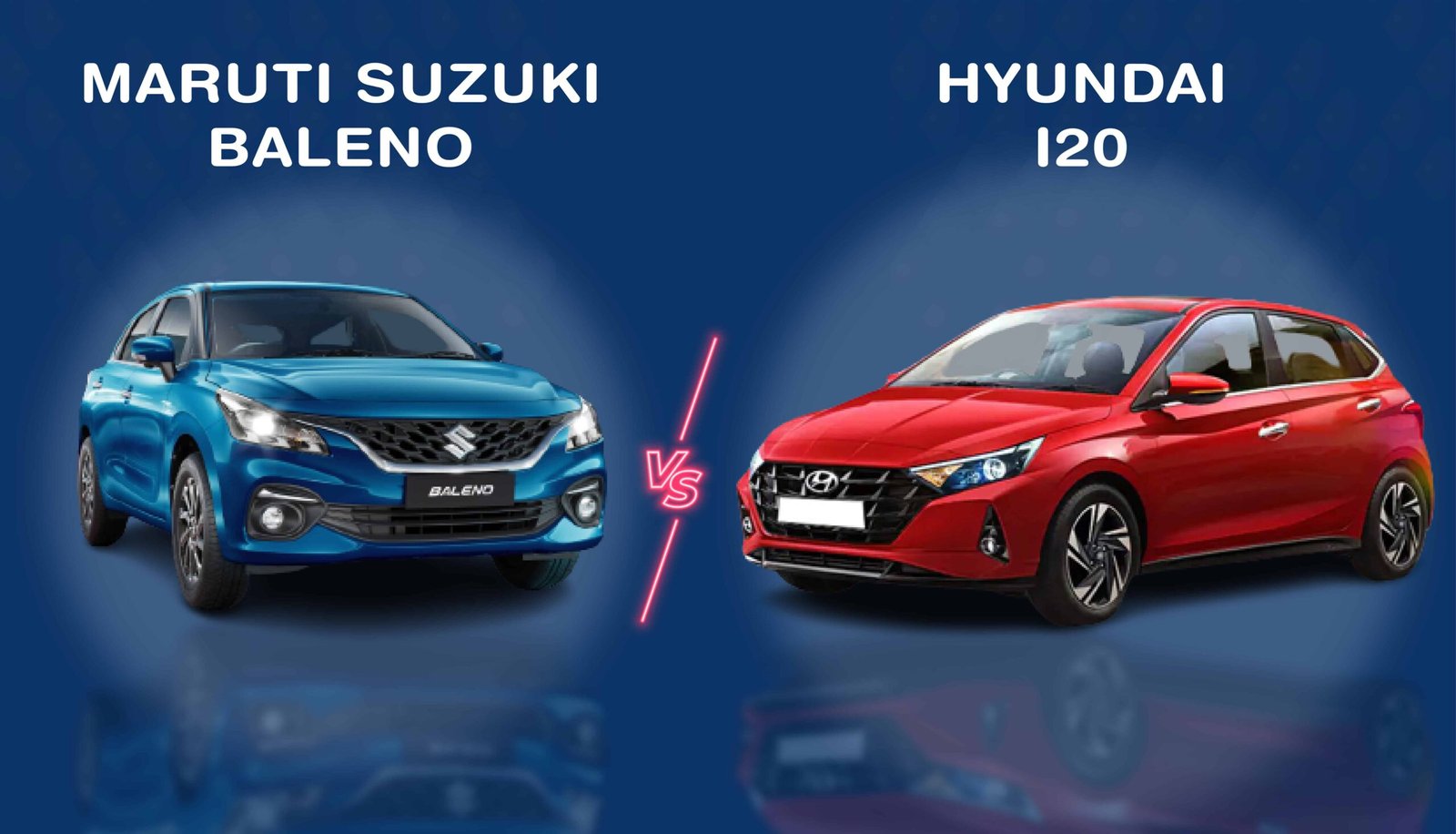
The battle for the premium hatchback crown has been a two-way tussle for years, with the Maruti Suzuki Baleno and the Hyundai i20 leading the charge. Both cars offer style, features, and comfort, but cater to slightly different priorities. Here is a detailed comparison to help you choose the winner for your garage.
1. Pricing and Value Proposition
| Feature | Maruti Suzuki Baleno | Hyundai i20 |
| Price (Ex-showroom) | Lower Starting Price (Approx. ₹6.70 Lakh) | Higher Starting Price (Approx. ₹7.04 Lakh) |
| Overall Value | Stronger VFM (Value For Money) due to lower starting price and better fuel economy. | Justifies higher price with more premium interior materials and feature depth. |
| Mileage (ARAI) | Higher (Approx. 22.94 kmpl) | Lower (Approx. 20.0 kmpl) |
| Maintenance | Generally Lower due to Maruti Suzuki’s widespread service network and parts cost. | Generally higher, but with competitive service packages. |
- Winner: Maruti Suzuki Baleno for the clear advantage in affordability, mileage, and running costs.
2. Engine and Performance
Both hatchbacks rely on a naturally-aspirated 1.2-litre petrol engine, but their performance and transmission options offer distinct flavors.
| Specification | Maruti Suzuki Baleno (1.2L DualJet Petrol) | Hyundai i20 (1.2L Kappa Petrol) | Hyundai i20 N-Line (1.0L Turbo Petrol) |
| Max Power | 88.5 bhp | 82-87 bhp | 118 bhp |
| Max Torque | 113 Nm | 115 Nm | 172 Nm |
| Manual Gearbox | 5-speed Manual | 5-speed Manual | 6-speed Manual (N-Line) |
| Automatic Option | 5-speed AMT (Automated Manual Transmission) | IVT (Intelligent Variable Transmission) – a type of CVT | 7-speed DCT (Dual-Clutch Transmission) (N-Line) |
| Performance Edge | Slightly higher power output in NA petrol. | More sophisticated CVT (IVT) auto gearbox for smoother city driving. | Offers a powerful Turbo-Petrol option for enthusiasts. |
- Winner: Hyundai i20 for the sheer choice of powertrain options, including the enthusiast-focused Turbo-Petrol engine with a superior DCT, and a smoother automatic (IVT) option.
3. Features and Interior
The interiors of both cars feel modern and premium, but they each highlight different technologies.
| Feature | Maruti Suzuki Baleno | Hyundai i20 |
| Infotainment | 9-inch SmartPlay Pro+ Touchscreen | 10.25-inch Touchscreen (Top-end) |
| Premium Tech | Head-up Display (HUD), 360-degree Camera | Bose 7-Speaker Premium Sound System, Single-Pane Sunroof (in some international markets/N-Line) |
| Convenience | Rear AC Vents, Cruise Control | Rear AC Vents, Cruise Control, Cooled Glovebox |
| Instrument Cluster | Digital Display in instrument cluster | Fully Digital Instrument Cluster |
| Cabin Feel | Spacious, lighter colours, functional design. | More sophisticated, superior fit & finish, ambient lighting. |
| Boot Space | 318 Litres | 311 Litres |
| Dimensions | Shorter wheelbase (2520 mm) | Longer wheelbase (2580 mm) for more cabin space. |
- Winner: Hyundai i20 for the more premium, feature-rich cabin experience (Sunroof, Bose audio), while the Baleno wins on practical tech (HUD, 360-degree camera) and boot space.
4. Safety and Build Quality
Safety is a crucial differentiator in this segment.
| Feature | Maruti Suzuki Baleno | Hyundai i20 |
| NCAP Rating | 4-Star (Bharat NCAP) | 3-Star (Global NCAP – old test protocol) |
| Airbags | 6 Airbags (Top Variants) | 6 Airbags (Top Variants) |
| Chassis | HEARTECT Platform | Enhanced High Strength Steel (HSS) |
| Key Safety Tech | ABS with EBD, ESP with Hill Hold Assist | ABS with EBD, ESC (Electronic Stability Control), Hill Assist Control, Vehicle Stability Management (VSM) |
- Winner: Maruti Suzuki Baleno for its recent, officially published 4-Star Bharat NCAP safety rating, providing a clearer indication of improved structural safety.1